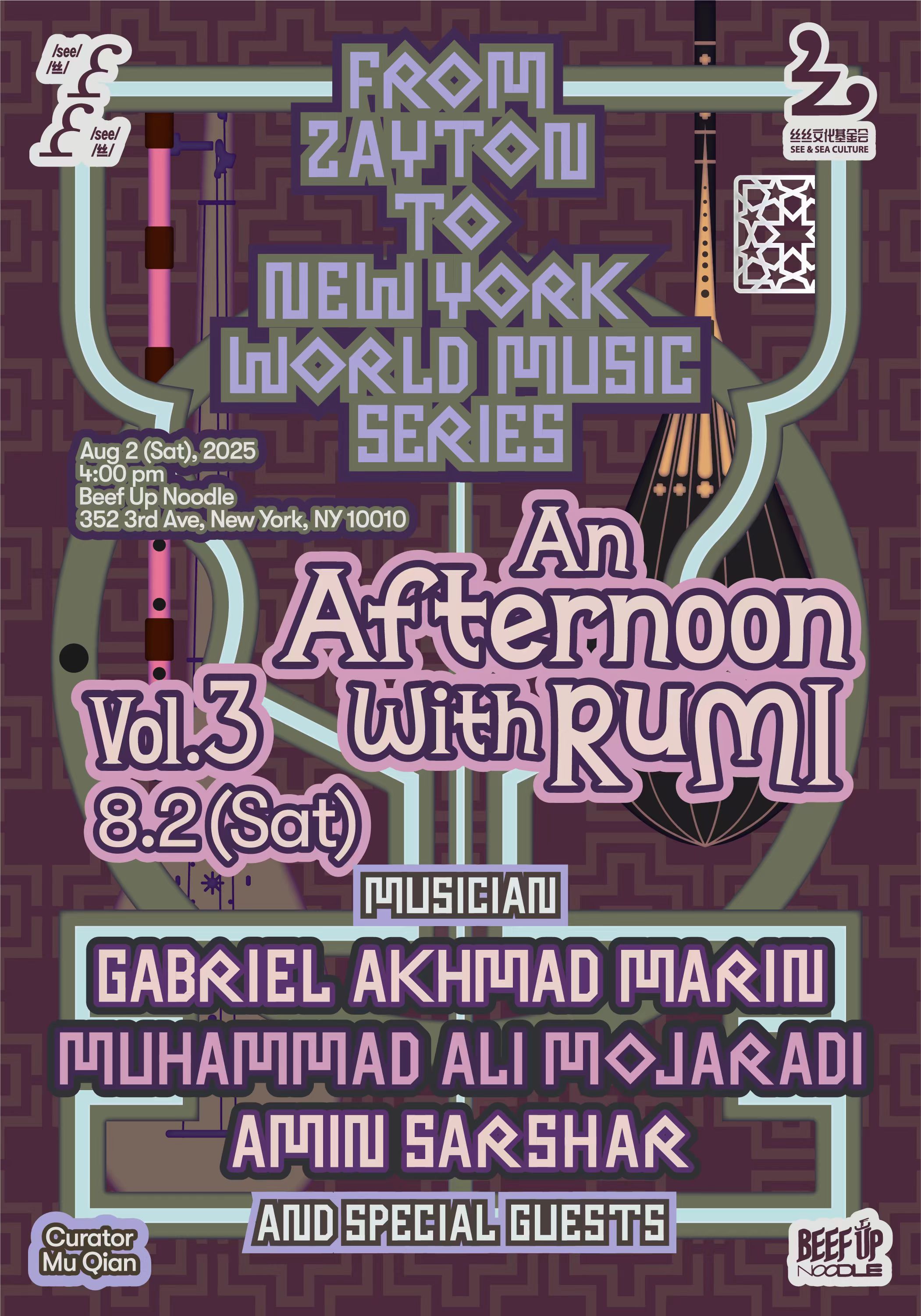
From Zayton to New York · Vol. 3
An Afternoon with Rumi
- Date
- Saturday, August 2, 2025
- Time
- 4:00 PM
- Venue
- Beef Up Noodle
352 3rd Ave, New York, NY 10010 - With
- Gabriel Akhmad Marin, Muhammad Ali Mojaradi, Amin Sarshar
- Presented by
- See See Records
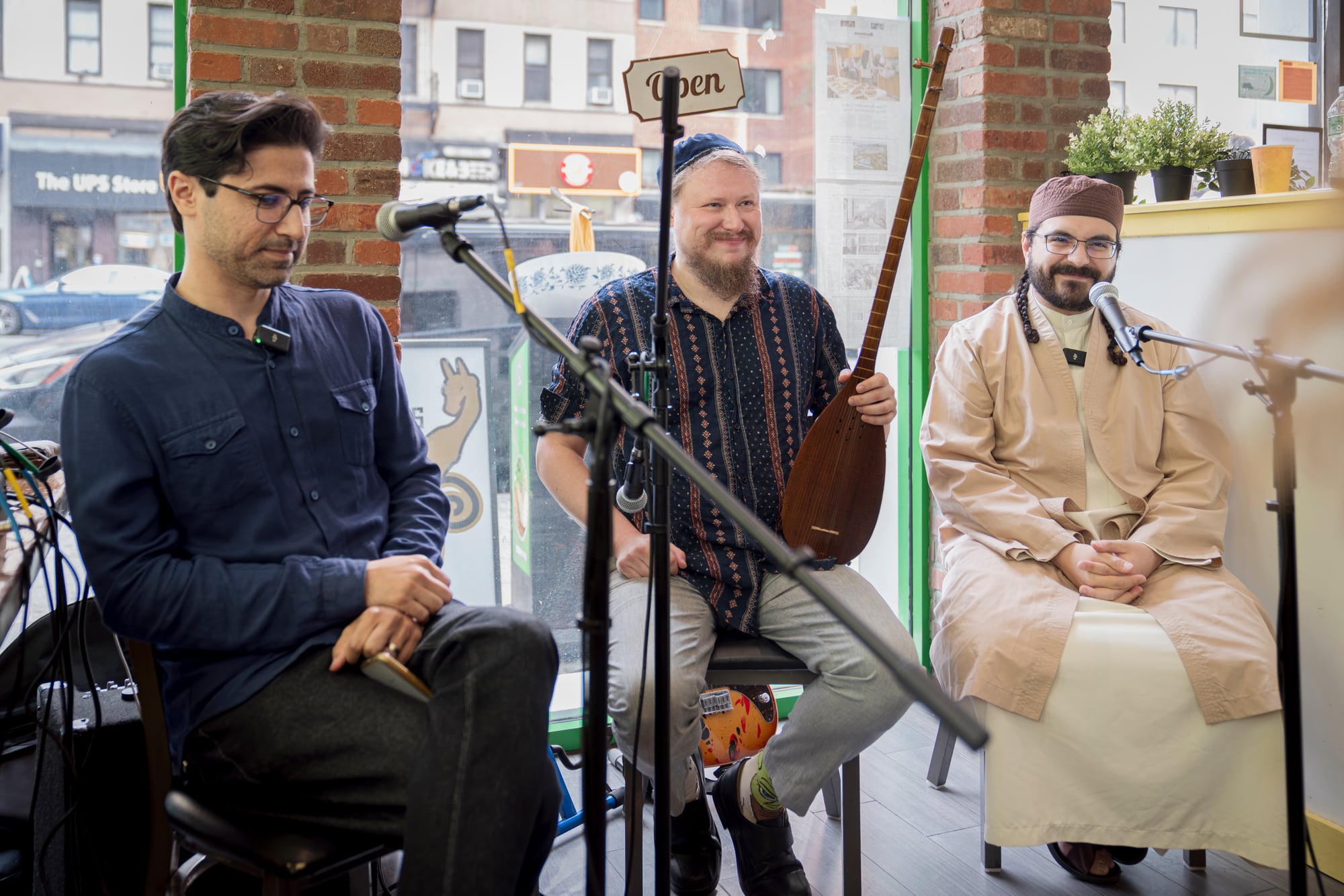
Poetry, music and spiritual reflection converge in a dialogue between word and sound, with works based on and inspired by the verse of the 13th-century mystic Jalal al-Din Rumi.
Curator’s note
Step into the timeless world of 13th-century mystic Jalal al-Din Rumi, where poetry, music, and spiritual reflection converge. An Afternoon with Rumi invites audiences to witness a unique dialogue between word and sound, as multi-instrumentalist Gabriel Akhmad Marin, poetry reciter Muhammad Ali Mojaradi, and vocalist Amin Sarshar present an immersive afternoon of works based on and inspired by Rumi’s verse.
Rooted in the mystical tradition of Sufism, Rumi’s poetry continues to resonate with themes of love, loss, divine longing, and unity. Mojaradi recites selections in both Persian and English, revealing their layered emotional and spiritual dimensions. Marin, a master of improvisation, responds with spontaneous musical interpretations shaped by the tone and texture of each poem. Amin Sarshar contributes a vocal perspective grounded in classical Persian forms, infusing the performance with lyrical nuance and devotional depth.
There is no predetermined script; each element arises in response to the others. Music, voice, and verse move in tandem, shaping a space that encourages reflection and presence. Whether you are well-versed in Rumi or encountering his poetry anew, An Afternoon with Rumi opens a path to listening deeply, where the ancient and the contemporary meet in the shared stillness of sound.
Rumi: a brief introduction
Jalal al-Din Rumi (1207–1273), widely known simply as Rumi, was a 13th-century Persian poet, mystic, and theologian whose legacy endures across cultures and centuries. Born in Balkh (in present-day Afghanistan) and later settling in Konya (in modern-day Turkey), Rumi became a towering figure of Sufism, the mystical dimension of Islam. His poetry explores themes of divine love, longing, unity, and spiritual transformation, offering a profound vision of the human soul’s yearning for the infinite. Through works such as the Masnavi-ye Ma’navi (Spiritual Couplets) and the Divan-e Shams-e Tabrizi, Rumi created a poetic language that blends emotion, philosophy, and mysticism in lyrical form.
Central to Rumi’s worldview was the transformative power of music and dance. He saw them not as worldly pleasures but as sacred tools for awakening the heart to divine presence. His mystical poetry was often recited or sung in spiritual gatherings. From this vision arose the practice of Sema, a ritual of whirling, music, and prayer that symbolizes the soul’s ascent toward God.
After Rumi’s death, his followers institutionalized these practices in the Mevlevi Order, a Sufi brotherhood founded by his son, Sultan Walad. Known for their whirling ceremonies, the Mevlevis preserved Rumi’s teachings and celebrated his poetry as both scripture and song. To this day, Rumi’s poetry remains deeply connected to music and dance, serving as a bridge between the inner and outer worlds, and as a living testament to the sacred unity of word, sound, and spirit.
Artists
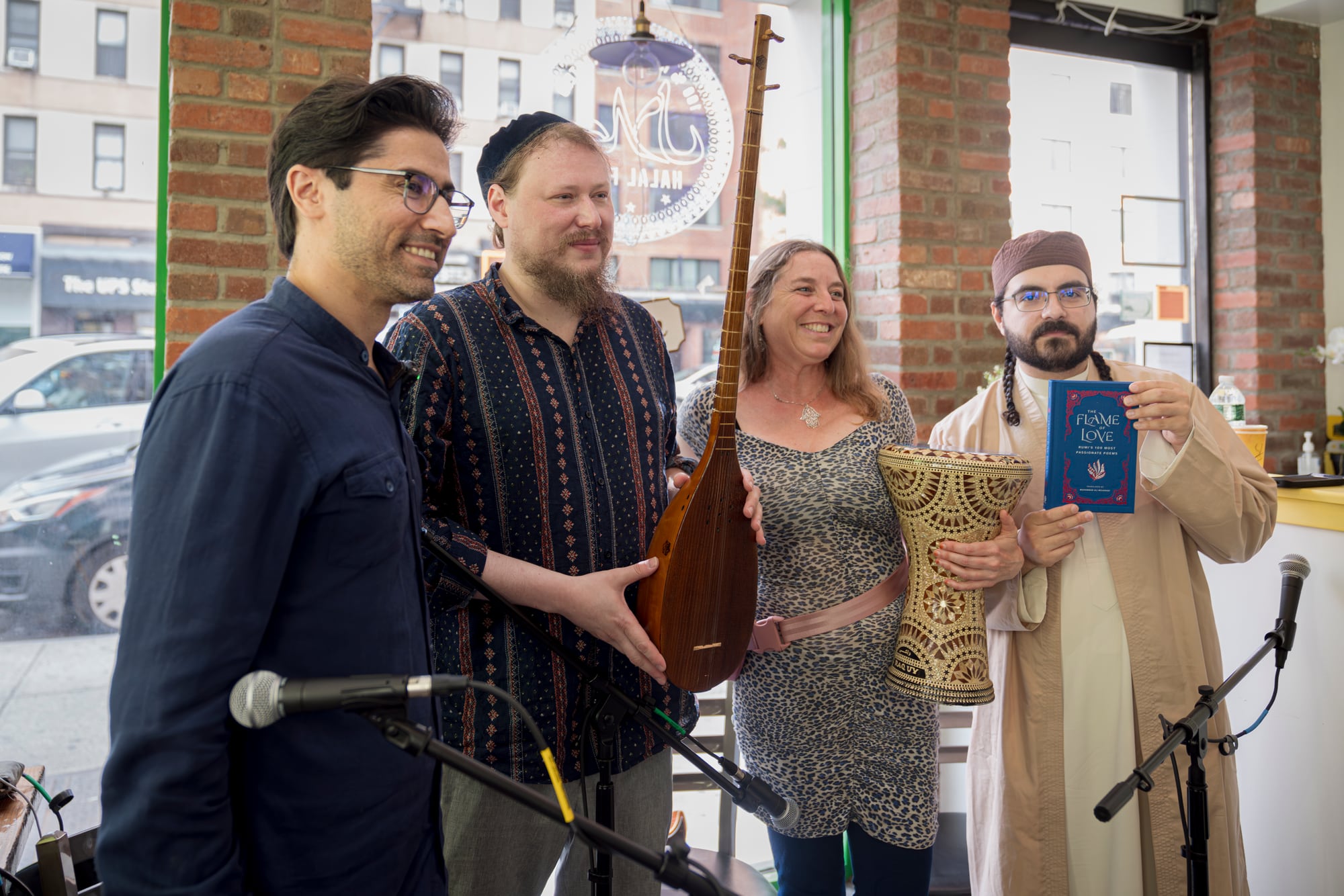
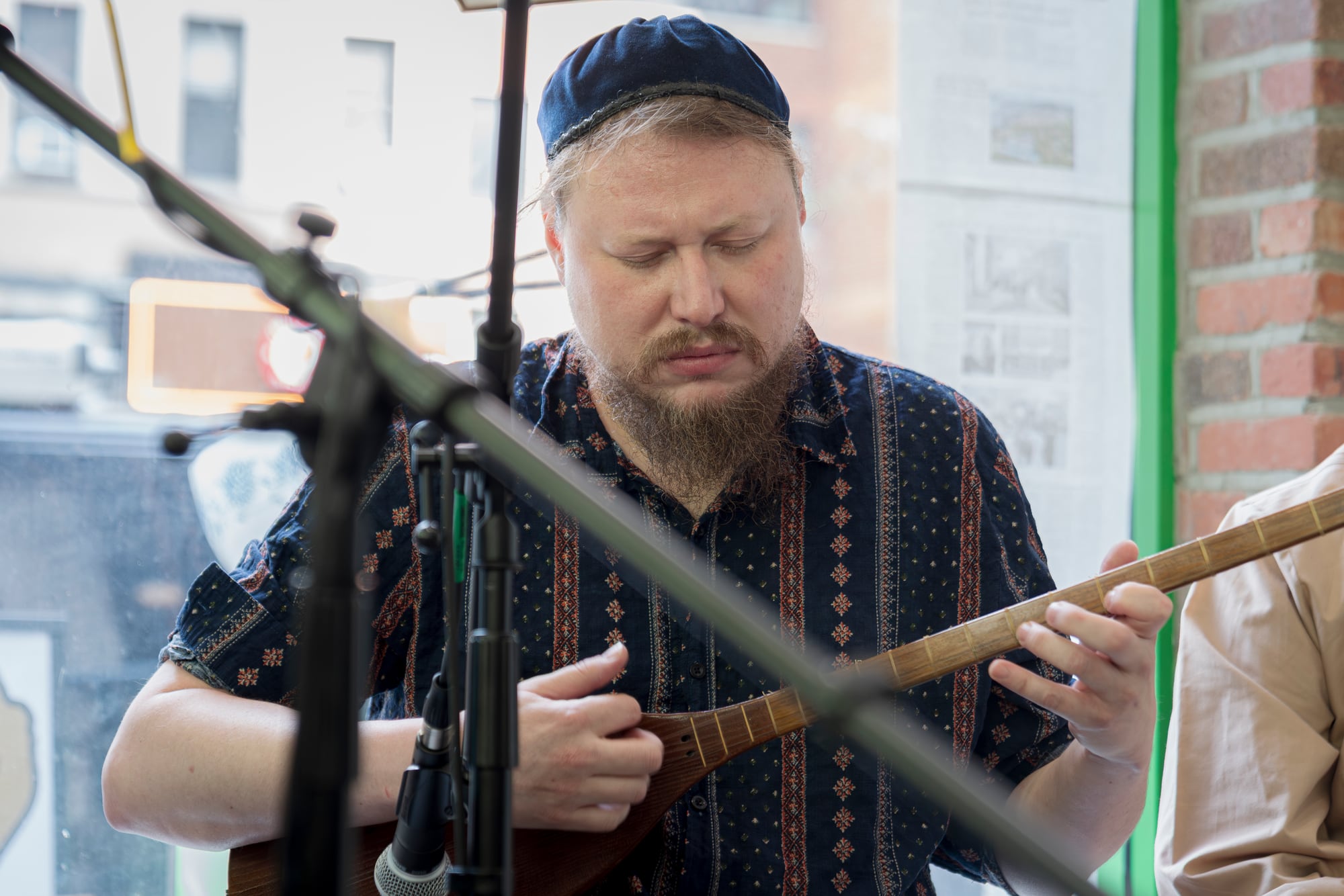
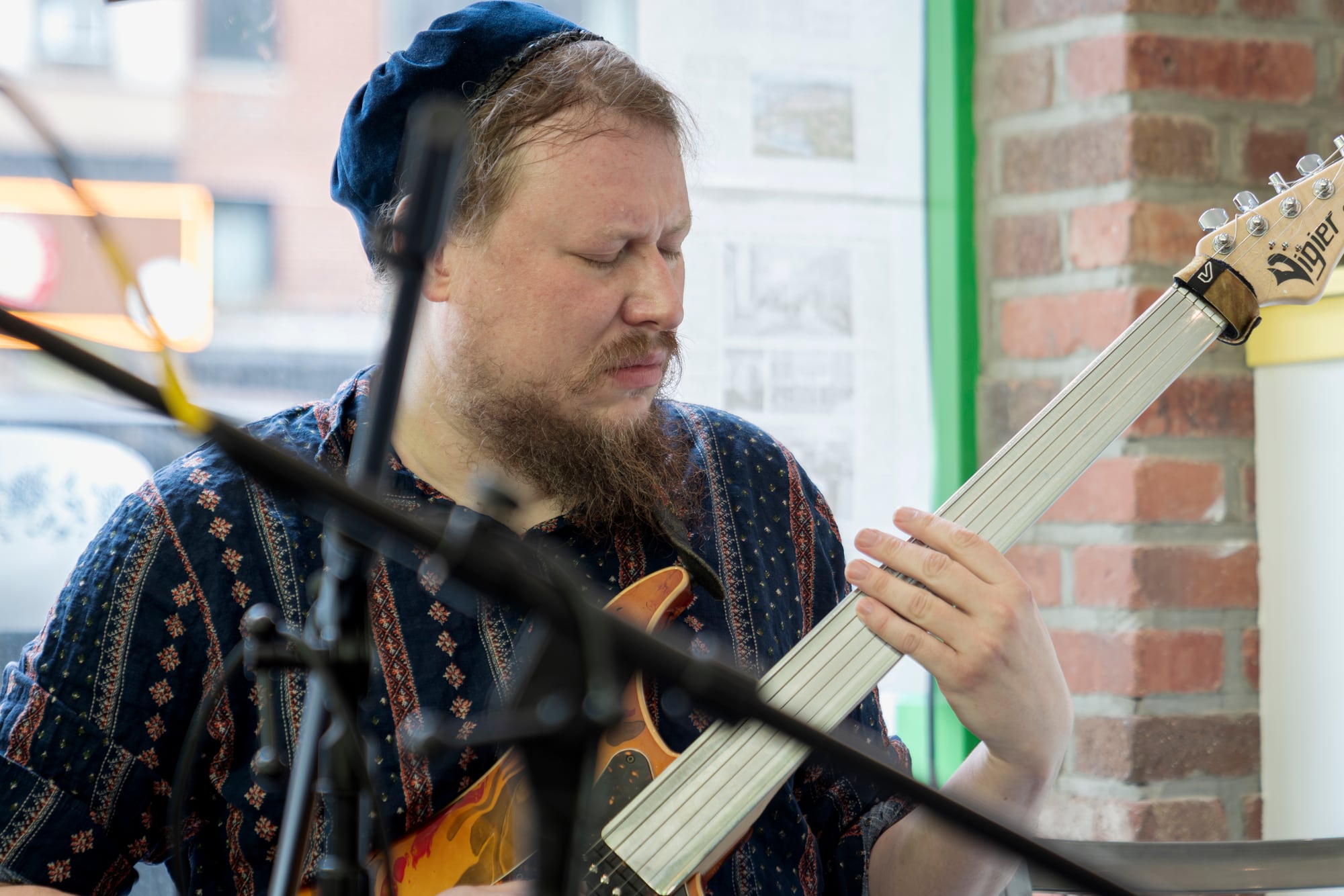
Gabriel Akhmad Marin is a multi-instrumentalist and composer known for his deep engagement with modal traditions from across the Silk Road. A third-generation immigrant of Caucasus and Balkan heritage, Marin is a follower of the Jerrahi Sufi order, where he plays music for the weekly dhikr (“remembrance”) ceremony. Hailed as a “master of the dutar” by NPR, Marin draws on musical lineages from Iran, Turkey, Central Asia, India, and beyond, blending them with his personal musical languages. His acclaimed solo album Ruminate spent months on the Transglobal World Music Chart and showcases his signature use of fretless guitar, dutar, and tanbur. Marin tours extensively across the U.S., Central Asia, and the Middle East, collaborating with master musicians. He is also a contributing artist and collaborator with the American Sufi Project, where he helps share Sufi devotional music through performance, education, and intercultural dialogue.
Muhammad Ali Mojaradi (pen name Sharghzadeh, meaning “struck by the east”) is a scholar, translator, and teacher of classical Persian poetry. Raised in Michigan by Iranian immigrant parents, he spent his teenage years in Tehran before returning to the U.S. to study Economics and Middle Eastern Studies at the University of Michigan, where he discovered his passion for Persian verse and founded the popular Instagram project Persian Poetics. He later pursued Arabic studies in Jordan and launched the viral #rumiwasmuslim campaign. Today, he leads live and online courses on Rumi, Hafez, Sa‘di, and more, and is the translator of the volume The Flame of Love: Rumi’s 100 Most Passionate Poems. As a lecturer and interpreter of Persian culture, he bridges classical literary heritage with contemporary global audiences.
Amin Sarshar is originally from Hamadan, Iran, and has performed with groups such as the Persian Music Ensemble. He was classically trained to sing Persian ghazals under the Persian Dastgah system. He received his PhD in mechanical engineering at Stevens Institute of Technology.
Photographs

Credits
- Curator
- Mu Qian @mu.qian.1
- Producer
- Shi Qianyi eveshi@seeandsea.org
- Poster design
- Haolun Liu @lhl_bicycle
- Sound engineer
- Kaiwei Yip @yippeekaiwei
With thanks to
- Barbash Family Fund
- New York Chinese Opera Society Inc
Presented by See See Records, the record label of See & Sea Culture Foundation, a 501(c)(3) non-profit organization.